

Beyond the Backyard Pop-Up
A heavy duty outdoor canopy tent is a commercial-grade shelter built with high-gauge steel frames, waterproof or UV-resistant fabric, and reinforced corners designed to withstand demanding weather conditions and repeated use. Key features to evaluate include:
- Frame Construction: Alloy steel tubing (~35 mm diameter or greater) with powder-coated finish
- Fabric Durability: Heavy-duty polyethylene with reinforced corners and grommets spaced every ~45 cm
- Stability Systems: Ground anchors, guy lines, and proper tensioning for wind resistance
- Design Types: Commercial pop-up canopies (portable, adjustable) or fixed-frame shelters (maximum strength)
The difference between a consumer-grade pop-up and a professional shelter comes down to engineering. Expert-tested commercial canopies use 17-gauge steel frames with secure pipe fittings, while typical backyard models rely on thinner materials that fail under stress. For event operators and field teams, a heavy duty outdoor canopy tent protects staff, equipment, and guests when conditions change fast. A consumer-grade canopy can fail without warning—creating safety hazards, equipment exposure, and forced shutdowns in active weather.
Operational experience with professional shelters in environments from desert heat to alpine snow reveals what makes a heavy duty outdoor canopy tent truly reliable. The focus for commercial operators must be on selecting shelter systems that deliver measurable durability, repeatable performance, and predictable operation in demanding weather. This analysis is based on extensive, expert-tested field use in commercial shelter deployment.
Deconstructing Durability: Core Components of a Heavy Duty Outdoor Canopy Tent

When we talk about a truly resilient outdoor shelter, we’re not just discussing a simple covering. We’re examining a carefully engineered system where every component plays a critical role in ensuring performance and longevity. This section establishes the criteria for what makes a heavy duty outdoor canopy tent a reliable, repeat-deploy shelter system.
The Frame: The Steel Skeleton of Your Shelter
The structural integrity of any outdoor canopy begins with its frame. For a heavy duty outdoor canopy tent, we insist on professional-grade materials. This means moving beyond lightweight aluminum or thin-walled steel found in recreational models. Our expert-tested preference is for alloy steel, specifically high-gauge steel tubing. For instance, frames constructed from ~35 mm Outside Diameter (OD), 17-gauge steel provide a robust foundation, far superior to lesser gauges that buckle under pressure.
Beyond the raw material, the finish is paramount. A powder-coated finish isn’t just for aesthetics; it’s a critical layer of protection against the elements, preventing rust and corrosion that can compromise the frame’s strength over time. This is especially important in diverse climates like the humid US Southeast or the coastal US Pacific Northwest. Furthermore, the connections between frame components must be secure. We look for designs that feature pipes sliding into secure fittings, often without reliance on springs or latches that can fail. This type of construction ensures a rigid, stable skeleton that won’t wobble or collapse when the weather turns.
The Fabric: Your First Line of Defense
Once the frame is established, the fabric forms the essential barrier against sun, rain, and wind. For a heavy duty outdoor canopy tent, the fabric must be as resilient as the frame. Heavy-duty polyethylene is a common choice, prized for its strength and weather resistance. The fabric’s weight and weave contribute directly to its durability, ensuring it can withstand repeated exposure and tension.
In a heavy duty outdoor canopy tent, UV protection and seam design determine whether the canopy holds up through repeated exposure. When it comes to moisture, understanding the difference between “waterproof” and “water-resistant” is vital. A water-resistant fabric will shed light rain for a period, but for critical operations and heavy downpours, a truly waterproof fabric with sealed seams and a higher-grade coating provides a complete barrier against water ingress. For severe weather, waterproof is the required standard.
Finally, pay close attention to the details that reinforce the fabric. Reinforced corners are essential, as these are high-stress points during assembly and in windy conditions. Double-stitched seams significantly improve durability, preventing tears and fraying. Grommets, used for securing the fabric to the frame and for anchoring, should be spaced approximately every ~45 cm to distribute tension evenly and prevent blowouts.
Anchoring and Stability: The Key to Wind Resistance
Even the strongest frame and most durable fabric are useless if a heavy duty outdoor canopy tent isn’t properly anchored. Wind is the nemesis of any outdoor structure, and a professional-grade canopy requires a comprehensive stability system. This includes robust ground anchors, which are often non-permanent and designed for secure embedment. For instance, our experience shows that a ~3 x 3 m canopy requires at least four anchors, while larger structures like a ~5.5 x 9 m canopy may need eight or more, each with a substantial base and sleeve for optimal hold.
Canopy weights, such as sandbags or concrete blocks, can provide additional ballast, particularly for pop-up styles or on surfaces where ground penetration isn’t possible. Guy lines, tensioned correctly and attached to appropriate anchor points, distribute wind load and prevent the canopy from lifting or swaying excessively. Heavy-duty stakes, driven deep into the ground, offer a reliable connection for these lines.
It’s imperative to consult manufacturer wind ratings for any heavy duty outdoor canopy tent you consider. While many commercial-grade canopies, when properly secured, are rated for sustained winds of 25-35 mph, these ratings are contingent on correct installation and anchoring. For guidance on specific site conditions or complex deployments, you can always contact our shelter experts. Always remember to Know Your Risk for Severe Weather and be prepared to de-escalate operations or dismantle the canopy if conditions exceed its rated capacity. Proper tensioning techniques for guy lines and fabric are crucial; a slack canopy is a vulnerable canopy.
Types of Professional-Grade Canopy Shelters
Selecting the right type of heavy duty outdoor canopy tent means matching the structure to your specific operational needs. From rapid-deployment options for dynamic operations to robust, long-term shelters, understanding the distinctions is key.

Commercial Pop-Up Canopies: For Rapid and Repeated Deployment
Commercial pop-up canopies are the workhorses of temporary outdoor operations, ideal for situations demanding efficient setup and disassembly. These heavy duty outdoor canopy tents are designed for portability and operational speed. Key features include adjustable height settings, allowing them to adapt to uneven terrain or varying clearance needs. A straight-leg design offers maximum footprint stability compared to angled-leg alternatives.
Their primary advantage lies in their rapid deployment, making them suitable for enterprise-scale operations in dense urban environments or remote field locations. Many come with roller carry bags, simplifying transport and storage. The versatility is improved by features like removable sidewalls, which can be added for privacy, weather protection, or branding. Common use cases include vendor booths, short-term operational shelters, mobile command posts, and temporary shade structures for work crews.
Heavy-Duty Frame Tents: For Maximum Strength and Extended Use
When superior stability and long-term deployment are the priorities, heavy-duty frame tents are the preferred choice. These heavy duty outdoor canopy tents feature fixed-pipe steel construction, creating an exceptionally strong and rigid structure. Unlike pop-ups, their frames are assembled piece by piece, resulting in a system capable of withstanding greater wind loads and prolonged exposure to the elements.
They offer larger footprints, with common sizes ranging from ~3 by 6 m to ~5.5 by 9 m and beyond, providing ample space for extensive operations. Their higher wind load capacity makes them suitable for more exposed locations, from wide-open desert basins to often-windy coastal regions. Heavy-duty frame tents are indispensable for long-term job sites, seasonal shelters, and outdoor commercial operations where the shelter is expected to remain in place for extended periods while protecting Total Cost of Ownership through reduced failure and replacement risk.
Critical Investment Considerations for Your Shelter
Making an informed selection means matching site conditions, wind exposure, and deployment frequency to the right shelter design.
| Feature | Commercial Pop-Up Canopies | Heavy-Duty Frame Tents |
|---|---|---|
| Portability | High (often with roller bags) | Moderate (requires more breakdown) |
| Typical Wind Resistance | Good (25-35 mph with proper anchoring) | Excellent (higher ratings possible) |
| Setup Complexity | Low (minutes for small sizes) | Moderate to High (requires more assembly) |
| Maximum Footprint | Up to ~3 by 6 m (often modular) | ~5.5 by 9 m and up |
Sizing Your Heavy Duty Outdoor Canopy Tent for the Mission
One of the first practical considerations is sizing. Whether you need a ~3 by 3 m canopy for a small vendor space or a ~3 by 6 m canopy for a larger operation, accurately calculating the required square footage is crucial. The calculation must account for both personnel capacity and equipment coverage. A proper assessment includes the total space required for all assets and people to be sheltered—including tables, equipment, and work areas—while ensuring adequate clearance for safe movement and operation. Underestimating space can lead to cramped, inefficient, and potentially unsafe environments, so it is critical to account for the complete spatial footprint of all internal elements, including buffer zones.
Maintenance for Longevity: Protecting Your Asset
A heavy duty outdoor canopy tent is a significant asset, and like any investment, it requires proper care to maximize its lifespan and return. Expert-tested cleaning procedures recommend gentle, non-abrasive methods to preserve fabric coatings and prevent damage. Crucially, proper drying and storage are paramount. Packing away a damp canopy is an invitation to mold, mildew, and fabric degradation, especially in humid climates. Ensure the fabric is completely dry before folding and storing it in a cool, dry place.
Regular frame inspection points are also vital. Check for any signs of rust, bent poles, or damaged fittings. Timely fabric repair, such as patching small tears, can prevent them from escalating into larger, more costly problems. By adhering to a diligent maintenance schedule, operators can significantly extend the operational life of a heavy duty outdoor canopy tent, reducing replacement costs, improving reliability, and enhancing Total Cost of Ownership performance over time.
Frequently Asked Questions about Heavy-Duty Canopies
What specific frame material is best for a heavy-duty canopy?
High-gauge, powder-coated alloy steel offers the optimal balance of immense strength, corrosion resistance, and manageable weight for professional applications. Avoid un-treated steel or thin-walled aluminum, as these materials lack the durability and weather resistance required for a true heavy duty outdoor canopy tent.
How much wind can a heavy-duty outdoor canopy tent withstand?
This is entirely dependent on the specific model, its design, and, most critically, the anchoring method. Commercial-grade canopies, when properly secured with heavy-duty stakes and guy lines, are often rated for sustained winds of 25-35 mph. However, you must always consult the manufacturer’s specifications for your particular heavy duty outdoor canopy tent and de-escalate use in severe weather conditions. Never exceed the manufacturer’s recommendations.
Are ‘waterproof’ and ‘water-resistant’ the same for canopy fabrics?
No, they are distinctly different. Water-resistant fabric will shed light rain for a period, offering temporary protection. However, truly waterproof fabric, often featuring sealed seams and a higher-grade coating, provides a complete barrier against water ingress even during heavy downpours. For critical operations where keeping contents absolutely dry is essential, waterproof is the required standard for your heavy duty outdoor canopy tent.
Conclusion: Investing in Uncompromising Shelter
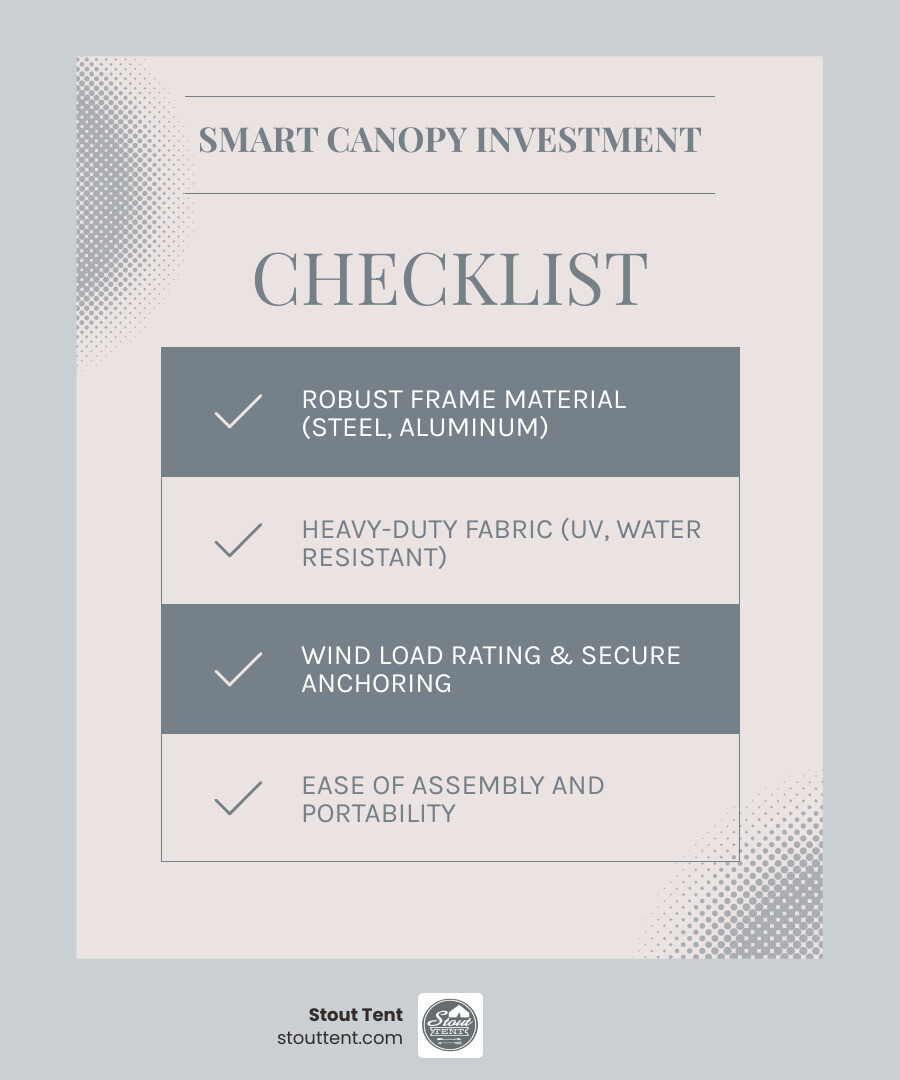
A true heavy duty outdoor canopy tent is a system of components working together: a robust frame, durable fabric, and secure anchoring. Choosing a professional-grade shelter is an investment in reliability, safety, and long-term value that prevents costly failures. As experts in creating durable, all-weather shelters, the team at Stout Tent understands that quality materials and construction are non-negotiable for serious outdoor use. We are committed to providing solutions that are expert-tested and built with professional-grade materials, ensuring your operations across Phoenix, Arizona, the Black Rock Desert, Nevada, California, Washington, and throughout the US Southwest, Southeast, Northeast, and Pacific Northwest are always well-covered.
For guidance on selecting the right shelter solution for your professional needs, contact our team.