

Why Camping Tent Rope Matters for Your Investment
Camping tent rope is the foundation of any secure shelter setup. When anchoring a bell tent for a glamping operation, the right rope and guy line system protects your investment and ensures guest safety.
Quick Answer: What You Need to Know About Camping Tent Rope
- Material: Use braided polyester rope (1/4″ to 3/8″ diameter) for professional applicationsit resists UV damage, doesn’t stretch excessively, and withstands repeated use
- Quantity: Plan for 100 feet of rope as a baseline, plus additional length for larger tents and auxiliary uses
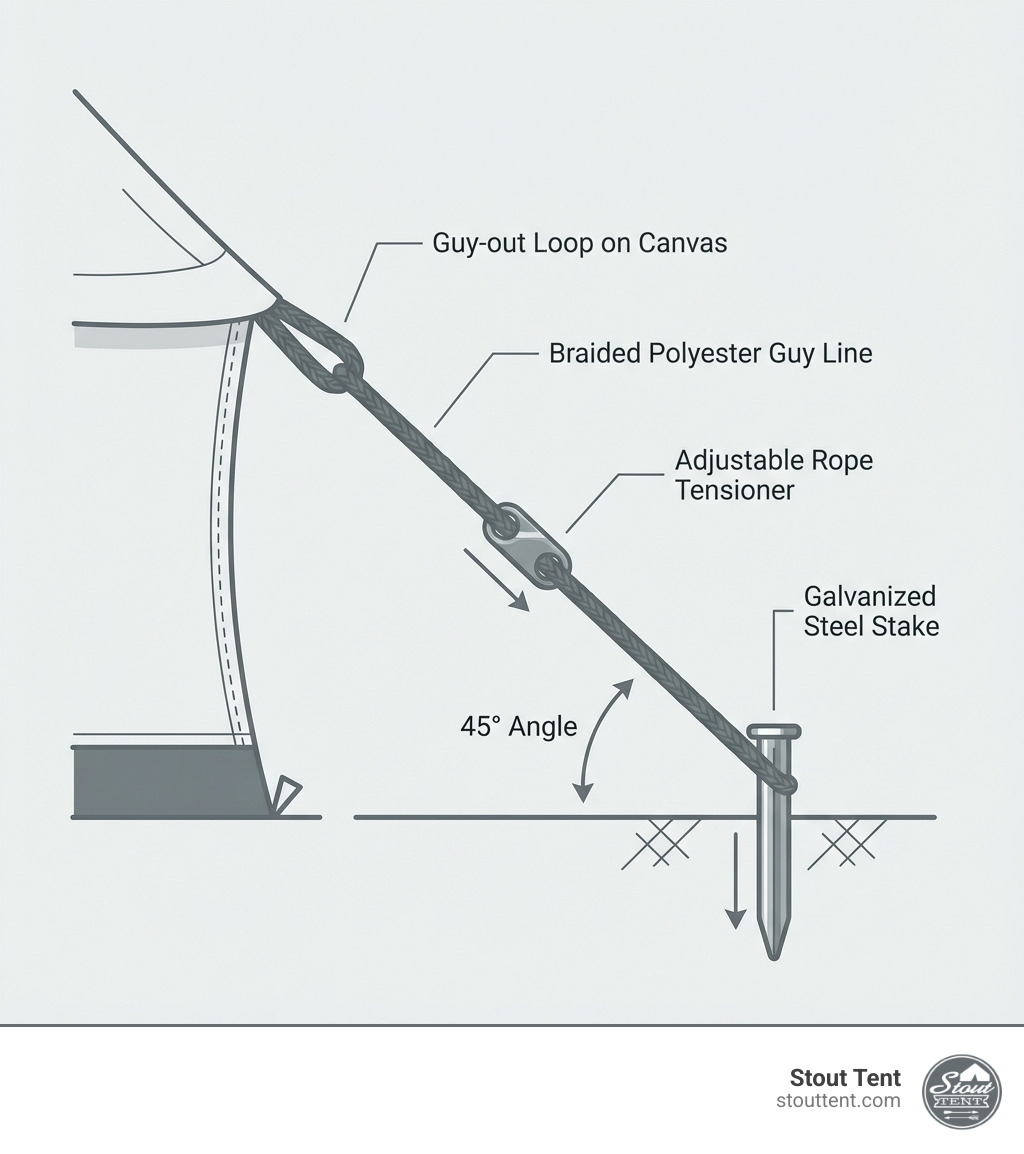
- Setup: Anchor guy lines at a 45-degree angle from tent to ground stake, ensuring even tension around the structure
- Essential Knots: Master the Taut-Line Hitch for adjustability, Bowline for secure loops, and Trucker’s Hitch for maximum tension
- Safety: Use high-visibility or reflective rope to prevent tripping hazards in high-traffic areas
The structural integrity of any canvas bell tent depends on proper tension and anchoring. Guy lines aren’t decorativethey’re critical load-bearing components that distribute wind forces, prevent canvas sag, manage rain and snow loads, and maintain the precise geometry that keeps your tent standing. For professional glamping operations, where downtime equals lost revenue and tent failure can compromise guest experience, understanding rope selection and setup protocols is non-negotiable.
Poor-quality rope stretches under load, degrades rapidly in UV exposure, and fails when you need it most. Natural fiber ropes like sisal or manila absorb moisture, develop mildew, and weaken over time. These aren’t suitable for professional-grade canvas shelters where durability and reliability directly impact your Total Cost of Ownership (TCO). The right camping tent rope system, properly deployed, extends the lifespan of your canvas investment and reduces emergency repairs.
Decades of hands-on experience deploying canvas bell tents in environments ranging from coastal winds to alpine snow loads have proven that camping tent rope selection and setup are critical factors in every successful installation. This guide distills that expert-tested experience into actionable, professional-grade protocols that can be implemented immediately.
The Critical Role of Guy Lines for Structural Integrity
A tent’s stability is a direct result of tension and structure, where guy lines play an indispensable role. Properly deployed guy lines distribute wind loads across the tent’s frame and canvas, preventing catastrophic failure in high winds and protecting the investment from damage. They are a non-negotiable element for any professional setup.
Why Guy Lines Are Essential
Guy lines are the unsung heroes of tent stability. They add rigidity to a tent’s structure, creating a stable setup that won’t easily give in under wind, rain, or snow. Beyond merely holding the tent upright, guy lines serve several critical functions that contribute to the overall performance and longevity of your canvas shelter.
First and foremost, they provide crucial stability in high winds. Without the outward tension provided by guy lines, a tent’s fabric acts like a sail, allowing wind to buffet and potentially collapse the structure. For robust bell tents, which are often used in exposed locations across the US Southwest, Pacific Northwest, and other regions, this reinforcement is paramount. Guy lines effectively brace the tent against lateral forces, ensuring it remains steadfast.
Secondly, guy lines are vital for managing rain and snow loads. They help pull the canvas material taut, ensuring water and snow shed off efficiently rather than pooling and creating stress points. This proactive measure prevents potential damage and leaks, reducing the need for premature repairs. If you do encounter damage, our Tent Repair Kit – Ultimate Guide can help you address issues promptly.
Furthermore, guy lines significantly improve interior comfort and tent health. They are often the sole support for a tent’s rainfly, keeping it properly separated from the inner tent walls. This separation is key to improving ventilation and reducing condensation, which can otherwise lead to damp interiors and potential mildew issues. By preventing the rainfly from touching the tent walls, guy lines facilitate airflow, allowing moisture to escape. Lastly, guy lines maximize interior space by preventing tent walls from caving inwards, a common issue in tents without adequate tension. This ensures that the full footprint of your bell tent remains usable, enhancing the guest experience.
Guy Lines and Tent Architecture
In the context of bell tents, guy lines are integral to their intuitive-pitch design and robust architecture. Bell tents rely on a central pole and an A-frame door pole, but the canvas tension and overall structural integrity are heavily influenced by the guy lines. They work in conjunction with the frame to distribute loads evenly across the canvas, maintaining the iconic bell shape and ensuring optimal performance.
The number and placement of guy lines needed will depend on the size of your bell tent. For instance, a 3-meter bell tent will require fewer and shorter guy lines than a larger 6-meter bell tent, which demands more extensive guying to manage its greater surface area and potential wind load. Stout tents are designed with ample guy-out points to accommodate these variations.
It’s not always enough to use only the standard guy lines. When facing adverse conditions like bad weather or high winds, deploying additional guy lines is not just recommended, it’s essential. These extra lines provide reinforced support, acting as secondary braces against extreme forces. For example, in the strong winds often experienced in the Black Rock Desert Nevada, or heavy rains in the Pacific Northwest, additional guying can be the difference between a secure shelter and a compromised setup.
The expert-tested strategy for bad weather involves orienting the tent correctly and maximizing guy line usage. It is advised to pitch your tent with its most robust side, or the side with the strongest pole structure, facing the prevailing wind. This minimizes the surface area directly exposed to the strongest gusts. Additionally, position doorways away from the wind to prevent rain and debris from entering the tent. Distributing guy lines evenly around the entire structure, especially on the windward side, will ensure maximum stability and protection for your professional-grade materials.
Selecting Professional-Grade Camping Tent Rope
The material and construction of your rope directly impact its performance, durability, and long-term cost of ownership. For heavy-duty canvas bell tents, selecting a rope with minimal stretch, high tensile strength, and superior resistance to environmental factors is paramount. Professional-grade materials ensure your shelter remains secure, reducing maintenance and replacement costs.
Choosing the Right Camping Tent Rope Material
When it comes to selecting camping tent rope, the material is a critical factor for ensuring stability and longevity, especially for high-value canvas bell tents. Synthetic ropes are strongly advocated for over natural fibers due to their superior performance characteristics and reduced maintenance requirements.
Here’s a comparison of key materials:
| Characteristic | Polyester Rope | Natural Fiber Rope (Sisal, Manila) |
|---|---|---|
| Stretch | Low (12-15% before breaking) | High (can shrink when wet) |
| UV Resistance | Excellent | Poor (degrades with sun exposure) |
| Water Resistance | Excellent (doesn’t absorb water, resists rot) | Poor (absorbs water, prone to mildew) |
| Abrasion Resistance | Good | Fair |
| Strength | High (strong and consistent) | Variable (weakens with moisture/age) |
Synthetic ropes, particularly polyester, offer significant advantages. Polyester rope stretches about 12-15% before breaking, which is half as much as nylon. This minimal stretch is crucial for maintaining consistent tension on your guy lines, preventing your tent from sagging or becoming unstable in changing conditions. Polyester also boasts excellent UV resistance, a vital characteristic for tents deployed in sunny regions like Phoenix, Arizona, or the US Southwest, preventing premature degradation of the rope. Furthermore, polyester performs exceptionally well in bad weather, being strong and water-resistant, ensuring reliability in rain or damp environments. For more data on performance characteristics, this overview of polyester rope strength is a useful technical reference when calculating safety margins.
Natural ropes, such as sisal or manila, are generally unsuitable for professional camping applications. They absorb moisture, which leads to mildew and rot, significantly weakening the rope over time. Manila, for instance, can shrink as much as 25% when wet, disrupting tension and potentially damaging your tent. These materials are not durable and are easily damaged by exposure to the sun, making them a poor choice for long-term outdoor use and a detriment to your TCO. Natural fibers should be avoided for any critical tent guying.
Construction: Braided vs. Twisted Rope
The method of rope construction also plays a significant role in its performance. For camping tent rope, braided construction is highly recommended over twisted.

Braided ropes are superior in several aspects. They are about 10% stronger than twisted ropes of the same material and size, offering a higher safety margin for securing your valuable canvas tent. Braided ropes are also more flexible, making them easier to handle and tie, and they maintain their shape better under tension. Their smoother texture is less prone to snagging and is more comfortable to work with. Critically, braided ropes are more durable and less prone to solveing or kinking, issues that can compromise the integrity of a twisted rope over time. These advantages make braided rope the professional standard for critical applications like tent guylines, where consistent performance and reliability are non-negotiable.
Twisted ropes, while often more affordable, come with several disadvantages. They are more prone to solveing, especially when cut or under stress, and can kink easily, making them frustrating to manage and less reliable in demanding conditions. The reduced strength and increased susceptibility to damage mean twisted ropes are not a wise choice for safeguarding a significant investment like a bell tent.
Load Capacity and Diameter for Your Camping Tent Rope
Understanding the load capacity and selecting the appropriate diameter for your camping tent rope is crucial for safety and longevity. For heavy-duty use with canvas bell tents, ropes in the 1/4 inch (6mm) to 3/8 inch (9.5mm) diameter range are typically recommended. This provides the necessary strength without excessive bulk. For instance, a 3/8 inch braided polyester rope is ideal for the heavy-duty jobs around camp, including hanging bear canisters or securing large loads.
Its important to distinguish between a rope’s breaking strength and its working load limit. The breaking strength is the maximum force a rope can withstand before failing. However, for practical and safe application, operations should use a working load limit, which is typically 20% to 30% of the breaking strength. For example, while 550lb paracord has a breaking strength of 550 pounds, its recommended sustained load is closer to 110-165 pounds. While 550 paracord is versatile for general camping needs, for the primary guying of a large canvas bell tent, professional-grade ropes with higher working load limits are essential.
When calculating load requirements for a large bell tent, especially in areas prone to high winds or snow, the tent’s surface area and the potential forces it will encounter must be considered. Our Guyline Rope Set – Set of 12 is designed with these considerations in mind, offering ropes specifically engineered for the demands of our tents. Properly sized and rated rope minimizes the risk of failure, protecting your investment and ensuring operational continuity.
Mastering Guy Line Setup and Tensioning
The methodology of setting up guy lines is as important as the materials used. A systematic approach ensures even tension, optimal stability, and a correctly pitched shelter. Following these expert-tested steps minimizes setup time and maximizes structural security.
Tying and Anchoring Guy Lines
Properly tying and anchoring guy lines is fundamental to the stability of your canvas bell tent. The goal is to create a secure, evenly tensioned system that distributes forces effectively.
First, attach one end of your chosen camping tent rope to the ‘guy out loops’ on your tent. These loops are specifically designed to be attachment points for guy lines.
Next, extend the guy line outwards from the tent body to determine the stake placement. The optimal angle for a guy line from the tent to the ground stake is 45 degrees. This angle provides the best balance between outward pull for stability and resistance to uplift.

Drive your stakes firmly into the ground, ideally vertically, for maximum holding power. Leaving enough stake exposed to slip a tie-down cord over it is practical.
Several common setup mistakes can compromise your tent’s stability. Over-tensioning can put undue stress on the tent fabric and seams, potentially causing damage or even tearing in strong winds. Conversely, loose lines provide insufficient support, allowing the tent to sag and flap. Incorrect angles for stake placement also reduce effectiveness; a line too flat or too steep won’t provide optimal resistance. Always ensure even tension across all guy lines, as uneven tension creates weak points in the overall structure.
Achieving Optimal Tension
Achieving optimal tension in your guy lines is an art and a science, crucial for both the stability and performance of your bell tent. Taut lines are essential because they prevent the canvas from flapping in the wind, which can cause wear and tear, and they distribute forces evenly across the tent’s structure.
Rope tensioners, also known as guyline adjusters, are highly recommended for use on each guy line. These small, often triangular or oval, devices allow for quick and precise adjustments to line tension. Simply slide the tensioner along the rope to tighten or loosen the line as needed. Alternatively, if tensioners are lost or unavailable, an adjustable knot like the Taut-Line Hitch can serve the same purpose effectively.
It’s vital to re-tension your guy lines in changing weather conditions. Canvas, being a natural fiber, can react to moisture. As canvas gets wet, it can stretch or relax, altering the tension. Regularly checking and adjusting your lines ensures your tent remains taut and secure, especially after rain or during temperature fluctuations.
Optimal tension directly impacts tent ventilation and interior space. When guy lines are properly tensioned, they pull the rainfly away from the inner tent walls, creating an air gap that significantly improves airflow and reduces condensation. This also prevents the tent walls from caving inwards, maximizing the usable interior space and ensuring a comfortable experience for occupants.
How Much Rope Do You Need?
Determining the amount of camping tent rope needed for your setup is a balance between preparedness and practicality. While it’s always better to have extra rope than not enough, some general guidelines can be followed.
As a baseline, a minimum of 100 feet of high-quality, professional-grade rope is recommended for general camping use. For heavy-duty applications with bell tents, a 100-foot spool of 1/4 inch (6mm) to 3/8 inch (9.5mm) braided polyester rope is an excellent starting point.
When calculating needs for a large bell tent, such as a 5-meter or 6-meter model, you’ll need sufficient length for each guy line, plus spare. Our bell tents come with pre-cut, high-quality guy lines, but having extra on hand for emergencies or custom setups is always wise. For instance, you might need about 10 to 15 feet of rope for each primary guy line point, depending on the tent size and desired stake distance.
Beyond the main tent guying, consider additional rope for other essential camping tasks. If you’re setting up a separate tarp for a cooking area or shade, plan for approximately 10 feet of rope per tie-off point. For practical uses like clotheslines, 15-25 feet of rope is usually sufficient. And for critical safety measures like hanging bear bags, especially in regions like the Sierra Nevada or other bear country, about 100 feet of robust braided polyester rope is recommended. For all your accessory needs, explore our full range of Camping Tent Accessories.
Essential Knots and Safety Protocols
Reliable knots are the foundation of a secure anchoring system. While many knots exist, professionals rely on a few proven options that are strong, secure, and adjustable. Equally important are the safety protocols surrounding your setup, particularly in busy campsites.
The Best Knots for Securing Guy Lines
Learning a few essential knots is a foundational skill for any professional managing a canvas shelter. For securing camping tent rope and guy lines, operations should rely on three expert-tested knots that are strong, secure, and highly functional:
-
Taut-Line Hitch: This is the go-to knot for adjustability. It allows you to create a loop on a line that can be slid freely to adjust tension, yet it holds firmly in place under load. This is perfect for fine-tuning the tautness of your guy lines as conditions change, ensuring your tent remains perfectly pitched.
-
Bowline: The Bowline creates a fixed, non-slip loop at the end of a rope. This knot is used to securely attach the guy line to the guy-out loop on the tent or to a fixed anchor point like a tree trunk. It’s renowned for its reliability and ease of untying, even after bearing a heavy load.
-
Trucker’s Hitch: This knot provides a mechanical advantage, allowing you to create significant tension in a line, almost like a pulley system. It’s invaluable for securing and tensioning guy lines to stakes, especially in high winds where maximum tautness is desired. It ensures your canvas remains drum-tight.
When tying any knot, always practice “dressing” it properly. This means arranging the knot’s components neatly and cinching it down firmly. A well-dressed knot is stronger, more reliable, and easier to inspect than a sloppily tied one.
Guy Line Visibility and Campsite Safety
Ensuring guy line visibility is paramount, especially in busy campsites or when children are present. Tripping hazards are a common concern, and a simple fall over a guy line can lead to injury or damage to your valuable tent.
Using high-visibility rope or reflective cordage for your guy lines is strongly recommended. Fluorescent orange or neon green ropes are excellent for daytime visibility, while reflective materials woven into the cordage will glow brightly under a flashlight at night, significantly reducing tripping incidents. For additional safety, especially around children, tie brightly colored ribbons, survey flags, or even caution tape to the middle of each guy line.
Strategic tent placement also plays a role in safety. Pitching your bell tent slightly away from main foot traffic areas, where possible, can minimize exposure to accidental trips. Educate all campers, particularly children, about the presence of guy lines and the importance of being aware of their surroundings.
Regular rope inspection is another critical safety protocol. Before each setup and periodically during use, inspect all your camping tent rope for signs of fraying, cuts, or excessive wear. Any damaged ropes should be replaced immediately with manufacturer-approved alternatives to prevent potential failure.
Rope Care and Maintenance
Proper care and maintenance of your camping tent rope will significantly extend its lifespan, ensuring continued reliability and maximizing your Total Cost of Ownership (TCO).
For synthetic ropes like polyester, cleaning is straightforward. Use mild dish soap and water to gently wash away dirt and grime, then rinse thoroughly. Allow the ropes to air dry completely before storing them. Avoid harsh chemicals or machine washing, which can damage the fibers.
Proper storage is crucial. Always store your ropes in a clean, dry, and well-ventilated area, away from direct sunlight and extreme temperatures. Coiling ropes neatly prevents tangles and kinking, making them easier to deploy next time.
Avoiding UV degradation is key to rope longevity. While polyester ropes have excellent UV resistance, prolonged exposure to intense sunlight, such as that in the US Southwest, will eventually cause degradation. When your tent is packed away, ensure the ropes are stored out of direct sunlight.
Before each use, perform a thorough inspection of all your ropes. Look for any signs of fraying, cuts, flat spots, or discoloration. These are indicators of weakening and potential failure points. Replacing compromised ropes proactively is far more cost-effective than dealing with a tent collapse. For comprehensive repair guidance, consult our Canvas Tent Repair Guide 2025. By adhering to these simple care routines, you ensure your camping tent rope remains in peak condition, ready to secure your canvas shelter reliably for years to come.
Conclusion
Mastering the use of camping tent rope is a crucial skill that safeguards your shelter, improves its performance, and protects your long-term investment. By selecting professional-grade materials, employing correct setup techniques, and adhering to rigorous safety protocols, you ensure your canvas bell tent delivers unparalleled reliability and durability. Stout Tent is committed to providing the highest quality components to support your most demanding outdoor needs.
Ready to upgrade your setup or need replacement parts? Explore our collection of durable tent components and accessories to ensure your shelter is always prepared for the elements.
Shop Replacement Bell Tent Parts | Browse All Canvas Bell Tents | Contact Our Support Team