

Why Proper Anchoring Makes or Breaks Your Canvas Shelter on Sand
Sand tent stakes are specialized anchoring solutions designed to hold tents securely in loose, shifting substrates where standard stakes simply pull out. For canvas bell tents, proper anchoring is a structural and safety requirement, not an optional upgrade. Recommendations in this guide are based on expert-tested setups and tent hardware deployed across demanding locations, from the Black Rock Desert in Nevada to exposed coastal sites.
Top Sand Tent Stake Options:
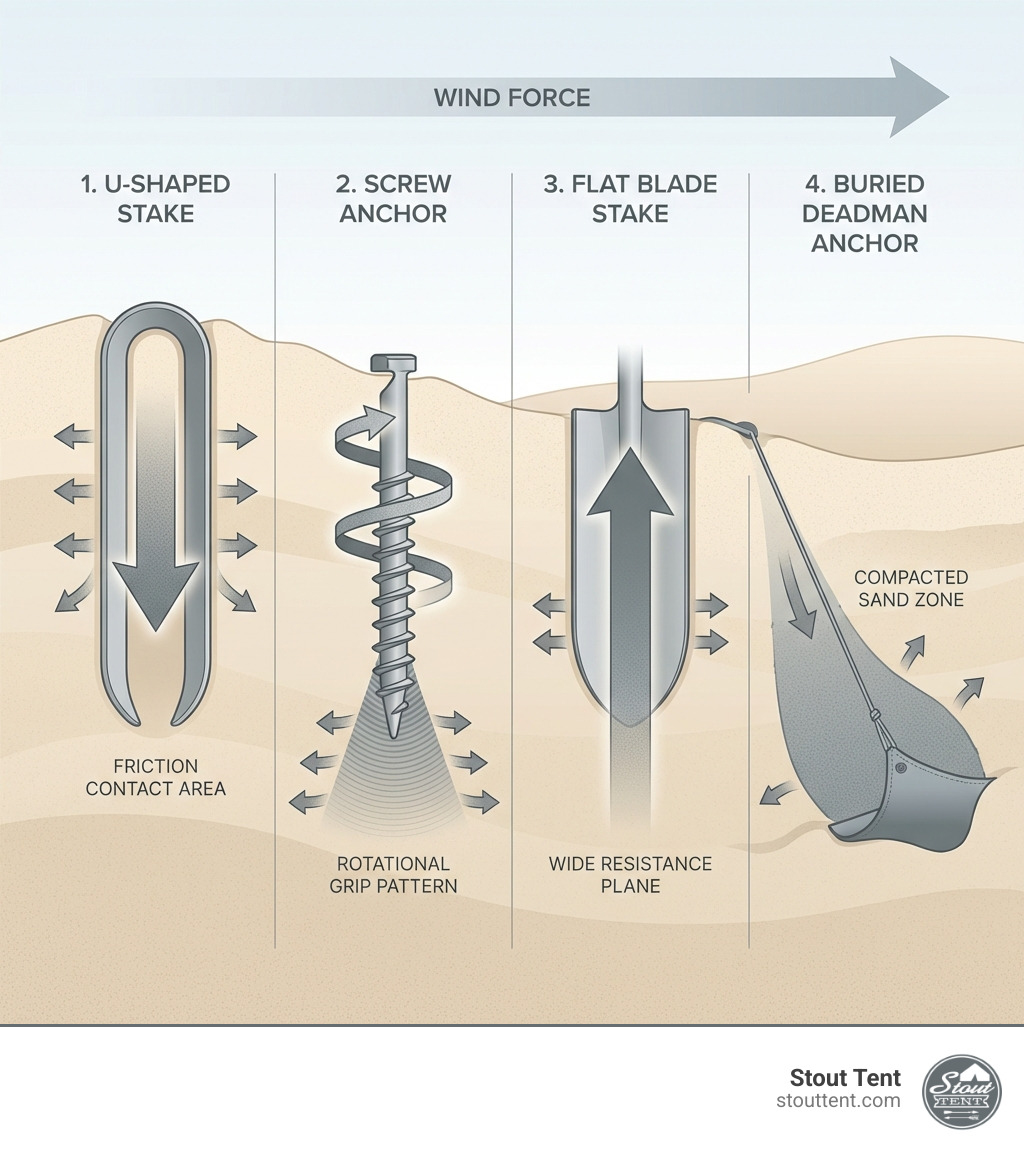
- U-Shaped or V-Shaped Stakes – Broad profile creates more surface area for friction in loose sand (~30+ cm recommended)
- Screw/Auger-Style Anchors – Twist into sand to create vertical holding power, works best in moderately compact sand
- Flat-Bladed Stakes – Wide surface area increases resistance to pull-out in soft ground
- Fabric “Deadman” Anchors – Buried horizontally ~30-40 cm deep, these parachute-style anchors scoop sand for maximum hold
Key Features to Look For:
- Length of 30 cm minimum (longer for very loose sand)
- Durable, professional-grade materials like aluminum alloy or engineered thermoplastic
- Multiple guyline attachment points
- Wide profile to maximize surface contact with sand
Standard tent stakes fail in sand because they rely on narrow profiles designed for dense soil. Sand offers minimal shear strength, so stakes need significantly more surface area and depth to generate adequate friction and holding power against wind loads. This aligns with basic soil mechanics principles used in civil engineering and federal hazard guidance on soil behavior, where loose substrates require broader anchors to resist pull-out.
Recommendations for sand tent stakes are informed by extensive hands-on testing in diverse environments, from coastal beaches to desert landscapes. Securing substantial canvas shelters in these settings requires professional-grade anchoring systems to ensure operational reliability and guest safety.
Understanding Substrate Dynamics: Why Sand Requires a Specialized Approach
Setting up a robust canvas shelter in sandy environments, whether it’s the vast expanse of the Black Rock Desert, a coastal beach in California, or a riverbank in the Pacific Northwest, presents unique challenges. Unlike dense soil that offers firm resistance, sand is a loose, granular substrate with distinct geotechnical properties. Its lack of cohesion and low shear strength means that regular, thin tent stakes, designed to penetrate and grip compact earth, will simply pull out with minimal effort, especially under the relentless force of wind.
From a soil mechanics perspective, dry, loose sand behaves very differently from compact, moist soil. Guidance from the U.S. Geological Survey on liquefaction and granular soils highlights how low-cohesion materials can quickly lose bearing capacity under load. In practical terms for camping, this means your anchoring system must be designed to work with sand’s tendency to shift and flow.
The fundamental difference in how sand tent stakes work compared to their conventional counterparts lies in their interaction with the ground. Regular stakes rely on the soil’s ability to resist displacement along the stake’s narrow profile. In sand, this resistance is almost non-existent. Instead, specialized sand stakes are engineered to create a larger surface area within the sand, increasing friction and the volume of sand that must be displaced for the stake to fail. This principle is often likened to a “deadman” anchor or a parachute, where a large object or surface is buried to engage a significant mass of the surrounding material.
The advantages of using specialized sand tent stakes are immediately apparent. They provide significantly improved stability, preventing your shelter from shifting, collapsing, or even blowing away in a strong gust. This is not merely a matter of convenience; it is a critical safety consideration. Without proper anchoring, an unmoored tent can become a hazard, potentially causing damage to property or injury. Specialized stakes ensure the integrity of your setup, offering peace of mind and reliable shelter in environments where standard equipment falls short. Understanding these geotechnical properties of sand is the first step toward mastering the art of anchoring in soft ground.

A Comprehensive Guide to Specialized Sand Tent Stakes
Deploying canvas bell tents in sandy locations across the US Southwest or along the Atlantic coastline relies on a selection of expert-tested designs. Choosing the right tent replacement parts and employing effective techniques are paramount to maximizing holding power and ensuring unwavering stability.
Key Features of High-Performance Anchors
For optimal performance in sand, specific features are non-negotiable:
- Length: A critical factor. While some small plastic stakes are only \~14.5 cm long, they offer minimal holding power. A minimum length of 30 cm is generally recommended for sand stakes, with longer options of 45 cm or more providing superior hold. The deeper the stake penetrates, the more sand it engages, and the greater its resistance to pull-out. For extremely loose or soft sand, stakes up to 60 cm long have proven effective.
- Width and Surface Area: Unlike thin, needle-like stakes, effective sand anchors feature a broad profile. This can be a U-shape, a V-shape, a flat blade, or a spiral design. The increased surface area provides greater friction against the sand, preventing the stake from easily slipping through the loose grains. In loose substrates, holding strength is driven by contact area and embedment—two design priorities that separate sand tent stakes from standard pegs.
- Material Composition: Durability is key. Stakes must withstand the forces of wind and the abrasive nature of sand without bending, breaking, or corroding. Materials should be selected for both strength and longevity.
- Guyline Attachment Points: Secure and robust attachment points are essential. Features like a dual anchor-point head or a slot in the head of a peg ensure that guy ropes remain firmly connected, even under tension.
Common Designs for Sand Tent Stakes and Soft Ground
The market offers several designs, each with its own strengths in various sand conditions:
- U-Shaped/V-Shaped Stakes: These stakes, often referred to as snow/sand stakes, are characterized by their wide, trough-like profile. They perform well by displacing a larger volume of sand than traditional round or spike stakes. Y-shaped stakes are also noted for holding well in gravelly sand or denser soil. These are particularly effective in true, loose sand where their broad surface can compact the surrounding material.
- Screw/Auger-Style Anchors: These stakes are designed to be twisted into the ground, creating a deep, secure anchor point. Their helical design allows them to screw down into the sand, effectively compacting it around the shaft and providing excellent resistance to upward pull. Some versions are available in 45 cm lengths, offering significant depth. These work best in moderately compact sand, but can still be useful in looser conditions if buried deep enough.
- Broad, Flat-Bladed Stakes: Similar in principle to U-shaped stakes, these anchors present a wide, flat surface to the sand, maximizing resistance. While less common as dedicated sand stakes than U-shapes, the concept of a broad surface is fundamental to sand anchoring.
- Fabric “Deadman” Anchors: These are perhaps the most ingenious and effective solutions for very loose sand. These lightweight fabric panels are designed to be deployed like parachutes. You scoop sand or snow into the fabric, bury it horizontally ~30-40 cm deep, and the weight and displacement of the buried sandbag create an incredibly strong anchor. They are particularly effective because they engage a large, consolidated mass of sand.
Professional-Grade Materials for Durability
The material of your sand tent stakes directly impacts their longevity and performance, especially when dealing with abrasive sand and potentially corrosive saltwater air in coastal regions. Selecting professional-grade materials that align with recognized outdoor material performance standards helps ensure consistent reliability.
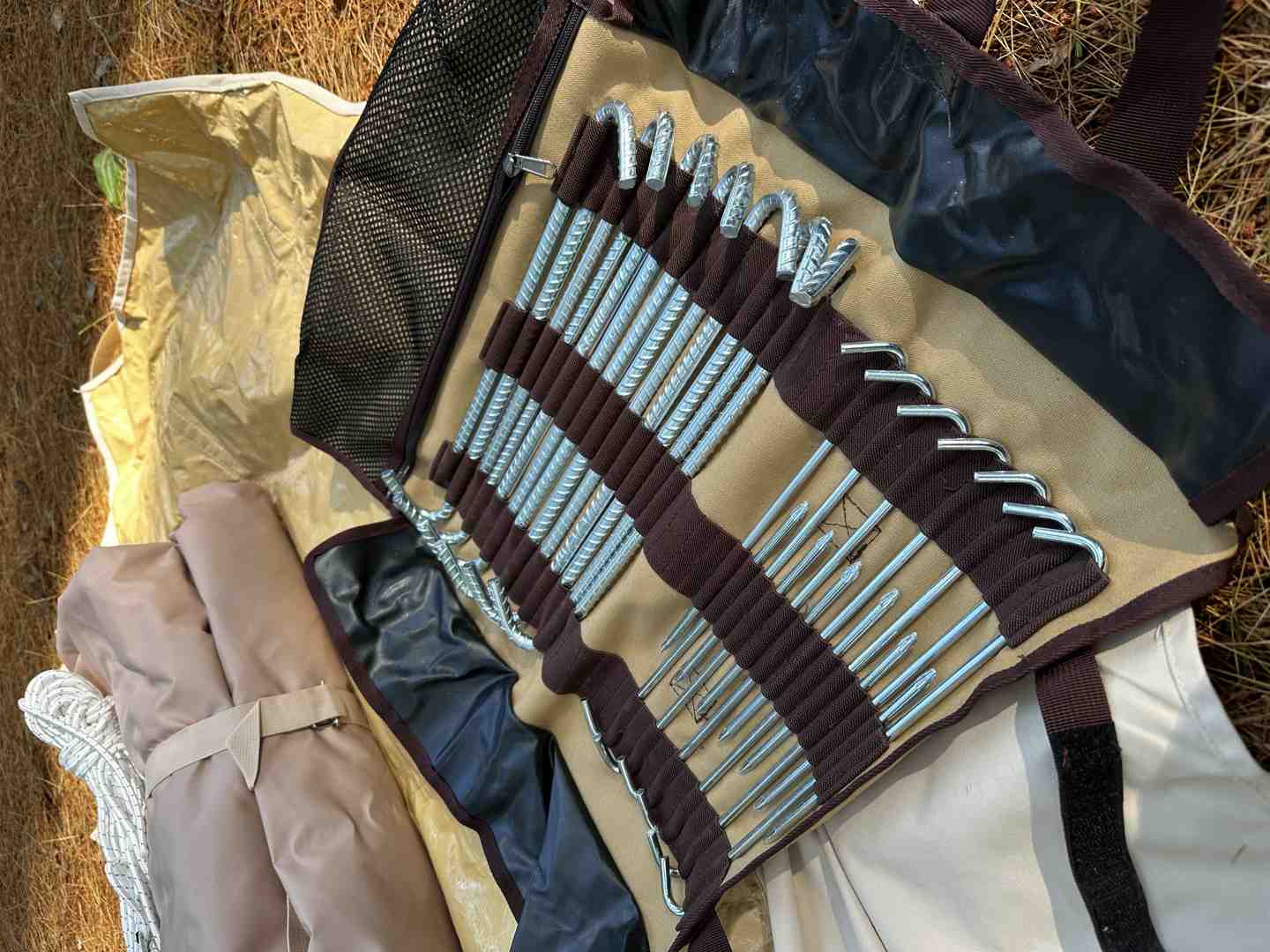
- Aluminum Alloys: Aluminum stakes, often found in U-shaped or military surplus designs, offer a balance of strength and lower weight compared to steel. They are naturally rust-resistant, which is a significant advantage in damp sandy environments. While generally lighter, some heavy-duty aluminum options can be quite robust.
- Engineered Thermoplastics: Modern materials like engineered thermoplastics with UV-protective treatments offer excellent durability, especially against UV degradation, which is crucial in sunny desert and beach environments. These materials can be molded into optimal shapes for sand, providing strength without excessive weight.
- Wood: Traditional wooden tent pegs, available in lengths of 30 cm or more, can be surprisingly effective for sandy ground. Their natural material and pointed shape allow them to penetrate and hold, especially when driven deep. While not as durable as metal or advanced thermoplastics, they are a viable option for certain applications.
| Stake Design | Best Sand Conditions | Key Features | Example Materials |
|---|---|---|---|
| U-Shaped/V-Shaped | Loose, soft sand; snow | Broad profile, high surface area, lightweight | Aluminum alloy, Engineered thermoplastic |
| Screw/Auger-Style | Moderately compact sand; mixed sand/soil | Twists into ground, deep anchorage, strong pull-out | Engineered thermoplastic |
| Broad, Flat-Bladed | Loose to moderately compact sand | Wide surface, good friction | Aluminum |
| Fabric “Deadman” Anchors | Very loose, deep sand; extremely windy conditions | Buried mass, adaptable to available fill, compact | Durable synthetic fabric |
| Wooden Pegs | Moderately compact to loose sand | Natural material, pointed, good length | Hardwood |
Field-Tested Techniques for Anchoring in Sand
Even with the best sand tent stakes, proper technique is crucial to maximizing the stability of your canvas shelter. Experience from large-scale deployments in challenging environments, from the Nevada desert to the US Southeast coast, reveals invaluable best practices. For a full breakdown of compatible hardware, review Stout Tent’s canvas bell tent parts and accessories alongside the techniques below.
The 45-Degree Rule for Optimal Tension
This fundamental rule applies universally, but it’s especially critical in sand. Always drive your stakes into the sand at a 45-degree angle, pointing away from the tent. This angle allows the stake to resist the outward and upward pull of the guyline most effectively, distributing the load across a larger volume of sand and significantly reducing the chance of pull-out. Ensure that all guylines are evenly tensioned to prevent undue stress on any single anchor point. This approach mirrors basic principles in FEMA wind load guidance, where anchors are aligned to counter expected force directions.
The Deadman Anchor: A Proven Method for Loose Substrates
The deadman anchor is a technique that shines in loose substrates like sand, especially when traditional stakes struggle. Instead of driving a stake vertically, you bury an object horizontally, connecting it to your guyline.
- Dig a Hole: For effective deadman anchoring, dig a hole approximately 30 to 40 cm deep, depending on the looseness of the sand and anticipated wind conditions.
- Prepare the Anchor: Wrap your guyline around a sturdy object. This could be a specialized fabric anchor, a stick, a rock, or even a stuff sack filled with sand. For large canvas bell tents, more robust solutions are often required.
- Bury the Anchor: Place the wrapped object horizontally at the bottom of the hole, ensuring the guyline exits towards the tent.
- Compact the Sand: Crucially, refill the hole, compacting the sand vigorously as you go. Walking on the sand around the anchor helps. In very loose sand, lightly dampening and then compacting the backfill can improve consolidation and increase holding power. This method is exceptionally effective because it engages a large, consolidated mass of sand. For more info about tent parts, including guylines, you can visit our site.
Leveraging Natural and Weight-Based Anchors
Sometimes, the best solution involves working with what the environment provides or utilizing readily available alternatives. This is particularly relevant in areas where driving stakes is difficult or where extra security is desired. These methods add redundancy when wind conditions demand more than sand tent stakes alone.
- Rock Stacking Technique: In rocky or gravelly sand conditions, you can improve a stake’s holding power by using rocks. Drive your stake as deeply as possible. Then, place a large, flat foundation rock over the stake’s ground entry point, running the guyline over it. Stack additional rocks on top of the foundation rock and behind the stake. This adds significant downward pressure and lateral resistance, preventing the stake from lifting. Remember to adhere to Leave No Trace principles by redistributing rocks after your stay, following environmental stewardship guidance from the National Park Service.
- Using Sandbags: Sandbags are a simple yet highly effective solution, especially for larger structures or when stakes are insufficient. Fill durable fabric bags with sand (at least 20 pounds each) and place them over your tent’s guylines or directly on the tent’s perimeter. Burying sandbags a foot or so deep further increases their effectiveness.
- Buckets of Water: On beaches, sturdy buckets filled with water provide substantial weight. Place them at each corner and tie-down point of your tent. This is a temporary but effective solution that can be easily deployed and removed.
- Wood Anchors: For a more robust weight-based anchor, drive long, sturdy pieces of wood (like 2x4s or even thick driftwood found on site) deep into the sand, parallel to the ground, and attach your guylines. This acts as a large, buried deadman anchor.
- DIY Methods: Ingenuity often provides excellent solutions. If you use improvised solutions, keep them simple, non-damaging, and aligned with your guyline loads—and prioritize purpose-built sand tent stakes for repeatable performance. For large shade structures, a portable drill can be used to create pilot holes for specialized anchors, highlighting the adaptability required in challenging sandy environments.
Frequently Asked Questions about Anchoring in Sand
Common questions about securing tents in sand highlight several key considerations.
How long should sand tent stakes be?
The length of your sand tent stakes is paramount. As a general principle, longer is better in loose sand. While some small plastic stakes might be as short as ~14.5 cm, these are often inadequate for anything beyond light breezes or very temporary setups. A minimum length of 30 cm is recommended for general sand camping. For truly loose, fine sand, or when anticipating strong winds, stakes of 45 cm or even 60 cm provide significantly superior holding power. This increased length allows the stake to engage a larger volume of sand, creating more friction and resistance to pull-out.
Can regular tent stakes be used in sand?
In most cases, no, regular tent stakes are not suitable for sand. Standard stakes, typically thin and short (often 15-20 cm), are designed to penetrate and hold in compact soil by creating a tight friction fit. Sand, being a loose, granular material with low shear strength, simply flows around these narrow stakes, allowing them to pull out easily, especially under wind load. While some Y-shaped stakes might offer a bit more purchase in gravelly sand or denser soil with some organic matter, they are generally not recommended for pure, loose sand. For reliable anchoring in sand, specialized wide-profile, U-shaped, screw-in, or deadman fabric anchors are essential. Using regular stakes in sand is a recipe for frustration and potential damage to your canvas shelter.
What is the best way to remove a deeply set sand stake?
Removing a deeply set sand tent stake can sometimes be a challenge, especially if the sand has compacted around it or if water was used to set it firmly. Here are some effective techniques:
- Loosen Surrounding Sand: The first step is often to loosen the sand immediately around the stake. You can do this by wiggling the stake back and forth, or by gently digging away some of the sand at the base.
- Wiggle and Rotate: For U-shaped or flat stakes, try to wiggle them side-to-side and rotate them slightly as you pull upwards. This helps to break the suction and dislodge compacted sand.
- Leverage: If the stake is particularly stubborn, you can use another stake, a rock, or a sturdy piece of wood as a lever. Place the lever close to the base of the stuck stake and apply upward pressure. Be careful not to bend or damage the stake.
- Screw-in Stakes: For screw-in anchors, simply twist them in the opposite direction (counter-clockwise) to unscrew them from the sand. This is generally the easiest type to remove.
- Fabric Deadman Anchors: These are typically removed by digging them up. Since they are buried horizontally, you’ll need to locate the buried object and unearth it. The advantage here is that the fabric itself won’t be damaged by hard pulling.
- Avoid Excessive Force: Never yank forcefully on a stuck stake, as this can bend the stake, damage the guyline, or injure yourself. Patience and a combination of these techniques usually lead to successful removal.
Conclusion: Ensuring Unwavering Stability for Your Canvas Shelter
Mastering the art of anchoring in sand is not just a skill; it’s a necessity for anyone venturing into sandy terrains, from the expansive deserts of Nevada to the picturesque beaches of California. This guide has explored the critical differences between standard and specialized sand tent stakes, delving into the unique challenges posed by loose substrates and the innovative solutions designed to overcome them. From the broad profiles of U-shaped stakes to the deep engagement of screw-in anchors and the unparalleled holding power of fabric deadman systems, the right equipment, combined with expert-tested techniques, ensures your canvas shelter remains a steadfast sanctuary.
The goal is to provide professional-grade materials and insights that stand up to the rigors of any environment. By understanding the principles of length, surface area, and material durability, and by employing best practices like the 45-degree rule and deadman anchoring, you can guarantee the unwavering stability of your canvas shelter.
For personalized advice on outfitting your shelter for any environment, contact our team of experts.